Online Quran Classes for Beginners: A Complete Starter Guide for Parents and Adults
Many people want to learn the Quran but do not know where to begin. Maybe you are a parent who wants your child to read the Quran correctly. Maybe you are an adult who never had the chance to learn as a child and now feels too shy to ask. Whatever your situation, online Quran classes for beginners make it possible to start from the very first Arabic letter, at your own pace, from your own home.
This guide walks you through exactly how a complete beginner can start, what a good learning path looks like, how parents can choose a suitable teacher, and what to expect in your first weeks. Everything here is written to help you decide with confidence.
Why Learning the Quran Online Works for Beginners
A few years ago, most families relied on a local mosque or a teacher living nearby. That still works for many people, but it can be hard to manage. Schedules clash, travel takes time, and finding a teacher who suits a child’s age or an adult’s confidence level is not always easy.
Online learning removes many of those barriers:
Flexible timing. You can book lessons around school, work and family routines, including across time zones.
Comfort and privacy. Adult beginners often feel more relaxed learning at home than in a group where everyone else already reads.
Wider choice of teachers. You are not limited to whoever lives in your area.
No commute. Time saved on travel can go into practice.
Easy to review. Many families find it helpful to revisit lessons, notes and homework in one place.
For families in the USA, this flexibility matters. After school activities, homework and work hours leave little spare time, and a short, consistent online lesson often fits better than a long weekly trip.
How Complete Beginners Can Start Learning Quran Online
If you are searching for Quran classes for beginners, the most important thing to know is that there is a clear path. You do not need any Arabic background. A good teacher will begin with the basics and move forward only when you are ready.
Step 1: Decide Your Goal
Be honest about what you want first. Some common goals are:
Reading the Quran correctly with confidence
Helping a child build a strong foundation
Learning Quran with Tajweed rules
Eventually memorising short surahs
Your goal shapes the course you choose and how your teacher plans your lessons.
Step 2: Check Your Starting Level
A beginner is someone who cannot yet recognise Arabic letters or who recognises them but cannot join them into words. A good academy will assess your level in a short first session so you are not placed too high or too low.
Step 3: Start with the Basics, Not the Quran Itself
This surprises many people. Beginners usually do not open the Quran on day one. They first learn the Arabic letters, their sounds, and how letters connect. Once those basics are in place, reading the Quran becomes far smoother and less stressful.
Step 4: Set Up a Simple Learning Space
You do not need special equipment. Most students need:
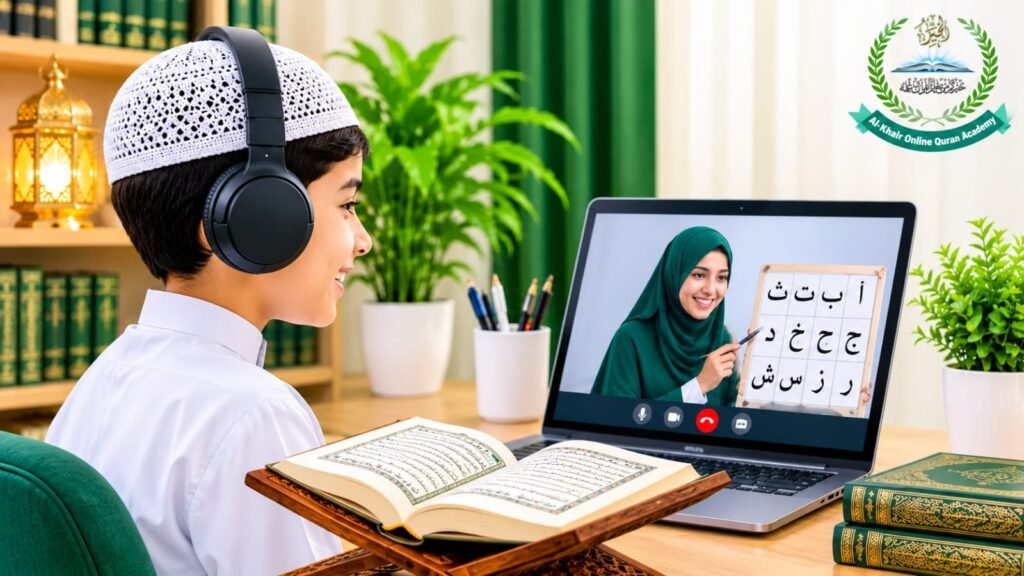
A laptop, tablet or phone with a stable internet connection
A working microphone and speakers or headphones
A quiet corner with minimal distractions
A notebook for new letters, words and teacher feedback
Step 5: Book a Trial and Meet Your Teacher
A trial class lets you experience the teaching style, check the audio quality, and see whether the teacher explains things in a way you or your child understand. Trying before committing is always sensible.
What You Will Learn: A Beginner’s Roadmap
A structured path keeps learning steady. While every academy arranges its curriculum differently, a typical beginner journey looks like this.
Arabic Letters and Pronunciation
Arabic has 28 letters, and several have sounds that do not exist in English. Letters such as ح, خ, ع and غ take practice, and small differences in pronunciation can change the meaning of a word. For this reason, hearing a teacher and repeating aloud is far more effective than learning from a book or video alone.
Pronunciation is also where basic Quran reading really begins. Correct sounds from the start prevent habits that are hard to fix later.
Noorani Qaida: The Foundation of Quran Reading
Noorani Qaida online courses are one of the most common starting points for beginners, and for good reason. Noorani Qaida is a step-by-step primer that introduces:
Individual Arabic letters and their sounds
How letters change shape when joined
Short and long vowel marks
Sukoon, shaddah and tanween
Simple rules of stopping and joining
It works like learning the alphabet and phonics before reading full books. Students who complete it well usually find that moving into the Quran feels natural rather than overwhelming. Both children and adults benefit from it, as it builds accuracy and confidence together.
Quran with Tajweed for Beginners
Tajweed means reciting each letter from its proper point of articulation with its proper characteristics. It is the way the Quran has been recited and taught for generations.
If you are wondering when to start, Quran with Tajweed for beginners does not have to be heavy or technical. Early on, it can be as simple as learning to stretch a vowel for the right length or to pronounce a letter from the throat rather than the tongue. A teacher introduces rules gradually and links them to the words you are reading, so they make sense in practice and not just in theory.
Moving into Quran Reading
Once letters, vowels and basic rules are comfortable, students begin reading short passages from the Quran, with the teacher correcting mistakes in real time. After that, many students continue to longer surahs, fluency practice, memorisation, or deeper Tajweed study.
Why Regular Practice Matters More Than Long Lessons
Quran reading is a skill, and skills grow with repetition. Ten to fifteen minutes of daily revision usually helps more than one long session each week. A few habits that help:
Revise the last lesson before each new class
Read aloud, not silently, so your teacher can correct you
Practise the same short section until it feels smooth
Ask questions when something is unclear
Be patient, since mistakes are a normal part of learning
Online Quran Lessons for Kids: What Parents Should Know
Children can learn very well online, provided lessons are structured around their age and attention span. Online Quran lessons for kids work best when they are short, interactive and encouraging.
Matching the Lesson to Your Child’s Age
Younger children, around five to seven, often learn better in shorter sessions with plenty of repetition and gentle praise. Older children can handle longer lessons and may be ready to learn Tajweed rules sooner. A good teacher adjusts as your child grows, instead of using one method for everyone.
How to Support Your Child at Home
Parents do not need to know Arabic to help. You can:
Sit nearby for the first few lessons to settle your child in
Set a fixed class time so it becomes part of the routine
Ask your child to show you what they learned that day
- Keep the screen and surroundings free from distractions during class
How to Choose an Online Quran Teacher for Your Child
Choosing the right online Quran teacher is the most important decision you will make. A great teacher builds love for the Quran. A poor fit can turn a child away from it. Here is what to look for.
Qualities of a Good Teacher
- Clear, correct recitation. Listen to how the teacher reads during the trial. Ask about their training in Quran recitation and Tajweed.
- Patience with beginners. Children and new learners need gentle correction, not pressure.
- Clear English communication. Especially for families in the USA, your child should easily understand explanations and instructions.
- Structured lessons. The teacher should have a clear plan, not just random reading.
- Regular feedback. You should know what your child is learning and where they need improvement.
Questions Worth Asking Before You Enrol
- What course or curriculum will my child follow?
- How are lessons structured, and how long is each class?
- Can I see or hear the teacher during a trial class?
- How will progress be shared with me?
- What happens if we need to reschedule?
- Will my child have the same teacher consistently?
A trustworthy academy will answer these openly. Be cautious of anyone who promises unrealistic results in a few days, since learning to read well takes steady effort.
Benefits of One-to-One Online Quran Classes
Group classes have their place, but beginners often gain a lot from one-to-one online Quran classes, where the teacher’s full attention is on a single student.
- Personal attention. The teacher hears every word you read and corrects mistakes immediately.
- Your own pace. You are never rushed to keep up, and you do not have to wait for others.
- More speaking time. In a group, each student gets only a few minutes of reading. One-to-one means you read most of the lesson.
- Comfort for shy learners. Children who hesitate in groups and adults who feel embarrassed often open up in private sessions.
- Flexible planning. The lesson plan can focus on your weak areas, such as particular letters or Tajweed rules.
- Easier scheduling. Timings can be arranged around your family’s availability.
For beginners especially, early corrections make a big difference because they prevent mistakes from becoming habits.
Adult Beginners: It Is Never Too Late to Start
If you are an adult who has never learned to read the Quran, you are far from alone. Many adults grew up without access to a teacher, moved countries, or simply never found the time. Starting later is perfectly fine, and adult learners often bring strong focus and motivation.
Common Worries and Honest Answers
“I feel embarrassed starting from zero.” A good teacher treats adult beginners with respect. Starting with letters is exactly how everyone begins, regardless of age.
“I have no Arabic background.” You do not need any. Noorani Qaida is designed for people with no prior knowledge.
“I am too busy.” Online lessons can be scheduled early in the morning, during a lunch break, or in the evening. Even short, regular sessions build real progress.
“Will I be able to learn at my age?” Adults may take a little longer to build muscle memory for new sounds, but consistent practice works. Many adult learners find that understanding the reasons behind rules helps them learn faster.
A Simple Plan for Adult Learners
- Start with Arabic letters and sounds
- Move through Noorani Qaida at a comfortable pace
- Practise a little every day, even for ten minutes
- Begin reading short sections of the Quran with Tajweed guidance
- Keep a notebook of the words and rules you find difficult
Tips to Get the Most from Online Quran Classes
- Be consistent. Regular classes matter more than occasional long ones.
- Join on time and prepared. Have your book, notebook and a working microphone ready.
- Record progress. Note what you learned each week to see how far you have come.
- Revise between classes. Short daily revision keeps lessons fresh.
- Stay patient. Progress can feel slow at first, then speeds up once the basics are secure.
Frequently Asked Questions
1. Can a complete beginner really learn Quran online?
Yes. With a patient teacher, a clear curriculum and regular practice, beginners of any age can learn to read the Quran online. Lessons start with letters and sounds, so no prior knowledge is needed.
2. What is the best age for a child to start Quran classes?
There is no single perfect age. Many families begin when a child can sit comfortably for a short lesson and recognise basic sounds, often around five or six. What matters most is a teacher who adjusts the lesson to the child’s attention span.
3. How long does it take to learn to read the Quran?
It depends on the student’s starting point, age, how often they attend, and how much they practise. Some students complete the basics sooner, while others need more time, and both are normal. A teacher can give a realistic estimate after your trial class.
4. Do I need to learn Noorani Qaida first?
For most beginners, yes. Noorani Qaida teaches letters, vowels and basic reading rules in a clear order, which makes reading the Quran much easier afterwards.
5. How many classes per week are best for beginners?
Many beginners do well with a few classes per week, because it keeps new material fresh. Fewer classes can work too if daily home revision is consistent. Your teacher can suggest a schedule after assessing your level.
6. What equipment do I need for online Quran lessons?
A device with internet access, a microphone, speakers or headphones, and a quiet place to sit. A notebook is also useful. Your academy will let you know which video platform it uses.
7. Are one-to-one classes better than group classes for beginners?
One-to-one classes give more reading time and personal correction, which many beginners find valuable. Group classes can be suitable for some students, but individual attention is usually more helpful in the early stages.
8. Can adults learn Quran with Tajweed from the start?
Yes. Adults can learn Tajweed alongside basic reading. A good teacher introduces rules gradually so that they are understood and applied, not just memorised.
Start Your Quran Journey with Confidence
Learning the Quran is a journey, and the first step is often the hardest. With the right guidance, online Quran classes for beginners can turn that first step into steady, joyful progress. Begin with the letters, build your foundation through Noorani Qaida, add Tajweed gradually, and keep practising regularly. Whether you are a parent looking for the right teacher for your child or an adult starting for the first time, you can learn in a calm, supportive environment from home.
Ready to begin? Book a free trial class at Al-Khair Online Quran Academy, meet an online Quran teacher, and see how lessons work for you or your child before you decide.

