Many Muslim adults carry a quiet secret. They love the Quran, they listen to it in the car, they hold the mushaf with respect, and yet they cannot read it fluently. Some were never taught as children. Some learned a little and lost it. Some can follow the script but stumble over every second word and feel a flush of embarrassment when someone is listening.
If that sounds familiar, please know you are far from alone, and you have not missed your chance. Quran classes for adults exist precisely for people in your position, and today you can join them from your living room in Houston, Birmingham, Toronto or Melbourne. This guide walks you through what the journey really looks like, how to start, what to expect, and how to choose a teacher who makes it comfortable.
Why It Is Never Too Late to Learn the Quran
Learning at an older age feels different from learning as a child. You may worry that your memory is slower or that you will look foolish. But adults bring real strengths to the classroom: focus, discipline, a clear reason for learning and the ability to ask good questions.
There is also a sincerity that comes with choosing to learn. Nobody is forcing you. You are sitting down after a long workday because you want a closer relationship with the Book of Allah. That intention is worth protecting, and a good teacher will treat it with respect rather than hurry you along.
The honest truth is that the first few weeks can feel awkward. Letters look alike, new sounds feel strange in the mouth, and progress seems slow. That is normal for every beginner at every age. It passes.
Why Many Adults Choose to Learn Quran Later in Life
The reasons are as varied as the students themselves. Some of the most common ones include:
- Growing up without access. Some families lived far from a mosque or teacher, or moved countries, and Quran lessons simply never happened.
- Reverting to Islam. New Muslims often want to read the Quran for themselves rather than rely only on translations.
- Becoming a parent. Many adults decide to learn so they can help their children, or so they are not learning at the same time as their kids.
- A personal turning point. A pilgrimage, a loss, Ramadan, or simply a quiet realisation that it is time.
- Wanting to fix old mistakes. Some read fluently but were never corrected on pronunciation and want to recite properly.
Whatever your story, there is no need to explain it to anyone. A professional teacher has heard it before and will simply meet you where you are.
Benefits of Online Quran Classes for Adults
For adults in the USA, UK, Canada and Australia, online learning solves problems that a local weekly class often cannot.
Privacy and comfort
Starting at the very beginning is far easier when you are not sitting in a room full of children or watching your peers read ahead. At home, you can make mistakes freely and repeat a letter ten times without feeling observed.
Flexible timing across time zones
You can book a session before work, during a lunch break, after the kids are asleep, or on weekends. If you live in Sydney or Vancouver, you are not limited to the opening hours of a nearby institute.
Access to qualified teachers
In many towns there simply is not a teacher who offers adult beginner lessons, or one who is available for women who prefer a female tutor. Online classes remove that geographic limit.
No commute
Travel time is often the first thing that kills a routine. Opening a laptop takes a minute. That small difference helps lessons survive busy weeks.
Can Adults Learn Quran from the Very Beginning?
Yes. Adults can learn to read the Quran from zero, including learning the Arabic alphabet, short vowels, joining letters and basic reading rules. Reading Quranic Arabic letter by letter is a skill, and skills are learned through guided practice, not talent.
What matters most is not your age but three things: a patient teacher, a sensible lesson plan, and regular practice between classes. Many students find that adult learners actually move steadily because they practise on purpose and understand why correction matters.
No one can promise an exact timeline, and be cautious of anyone who does. Progress depends on your starting point, how often you study and how much you revise at home.
How Adult Beginners Start Learning Quran
If you are not sure where to begin, this simple path works for most people.
Step 1: Be honest about your level
Tell your teacher plainly what you can and cannot do. Can you recognise any Arabic letters? Can you read slowly but not accurately? A short assessment in the first lesson helps place you correctly so you do not waste time repeating what you know or jumping ahead too soon.
Step 2: Start with the alphabet and sounds
Before reading words, you learn each letter, its name, its sound and where it comes from in the mouth and throat. This foundation is what makes later reading accurate.
Step 3: Move on to vowels and joining letters
Once letters feel familiar, you learn how short vowel marks change a sound and how letters connect to form words.
Step 4: Begin simple reading
With a steady base, you start reading short, easy passages with your teacher correcting you live.
Step 5: Add Tajweed gradually
Tajweed rules are introduced step by step alongside your reading so they stay manageable instead of overwhelming.
Learning Arabic Letters and Noorani Qaida
Noorani Qaida is a classic beginner text used across the world to teach Quran reading from scratch. It moves in small, logical stages: individual letters, joined letters, short and long vowels, tanween, sukoon, shaddah and more.
For adults, Noorani Qaida is valuable because it trains your eyes and tongue together. You are not guessing; you are building a reliable system. Many learners who attempted to “just read” the Quran before found that the same recurring mistakes disappeared once they went back and completed the Qaida properly.
A few practical notes for adult students:
- Don’t be discouraged if the Qaida seems like a children’s book. The content is foundational, and the way it is taught to adults can be quicker and more reflective.
- Aim for accuracy over speed. A clean letter sound now saves you correcting a habit later.
- Ask your teacher to record or note tricky sounds so you can practise them between lessons.
Quran Reading with Tajweed for Adults
Tajweed means reciting each letter correctly and giving it its due. It covers where sounds come from, how long to hold certain vowels, when a sound is merged or hidden, and when you pause.
Adults often feel intimidated by the word “Tajweed”, imagining a heavy technical subject. In practice, a good teacher breaks it into small rules you apply immediately to ayahs you are already reading. You do not need to memorise a rulebook before you open the mushaf.
If you already read the Quran but have never been corrected, a Quran with Tajweed course can gently refine your recitation. This is also a good route for adults who learned long ago and want to return with confidence. Live feedback is the key benefit, because you cannot always hear your own mistakes.
Benefits of One-to-One Online Quran Lessons
Group classes have their place, but adult beginners often do best in private sessions.
- The pace is yours. If you need to spend three lessons on a single sound, you can. If you pick something up quickly, you move on.
- Corrections are immediate. The teacher hears you alone, so small errors are caught on the spot.
- There is no comparison. You are not competing with anyone, which is a real relief for people who feel self-conscious.
- The lesson fits your life. Your teacher plans around your level, your goals and your schedule.
- You can ask anything. Questions that feel silly in a group are welcome in a private setting.
For women who prefer a female teacher, and for men who prefer a male teacher, private lessons also make it easier to feel comfortable and focused.
How Busy Adults Can Manage Quran Classes Alongside Work and Family
Most adult learners are not short of motivation. They are short of time. The good news is that consistent, small effort works better than occasional long effort.
Here are some realistic ways to make it fit:
- Anchor your class to an existing habit. Pick a time that already exists, such as right after Isha, before your commute starts, or during a regular lunch break.
- Practise in short bursts. Ten to fifteen minutes of daily revision usually beats one long session on the weekend.
- Use dead time carefully. Listen to the lesson recording or the passage you are learning while cooking or walking.
- Tell your family. Ask for a quiet room for thirty minutes. Many families become supportive once they know what you are doing and why.
- Be honest about your schedule. Ask for a plan that fits your week, and reschedule rather than quit when life gets chaotic.
If you work shifts or travel often, ask the academy how rescheduling works before you commit.
How to Choose the Right Online Quran Teacher
The teacher matters more than the platform. When comparing options, look for:
- Experience with adult beginners, not only children. Teaching adults requires a different tone and approach.
- Clear teaching of the basics. The teacher should explain letters, sounds and rules in plain language.
- Patience and encouragement. You should leave a lesson feeling guided, not judged.
- The option of a male or female teacher, according to your comfort.
- A structured plan with a clear starting point and next steps.
- A free trial. Nothing replaces trying a real lesson to see whether the teaching style suits you.
- Reliable technology and timing. Lessons should start when they are meant to and the audio should be clear.
During a trial, notice whether the teacher listens first, corrects kindly, and explains why a sound is made a certain way.
Common Challenges Adult Quran Learners Face and How to Overcome Them
Feeling embarrassed about starting late
This is probably the biggest barrier. Remember that every fluent reader began as a beginner. Choose a private teacher, keep your goal in mind, and measure progress against your own starting point, not against anyone else.
Confusing similar letters and sounds
Some Arabic sounds do not exist in English. Repetition with live correction is the answer. Short, frequent practice helps your mouth learn the shapes.
Missing lessons because of work or family
Agree on a back-up slot with your teacher and treat classes as appointments. If you miss one, reschedule quickly so you do not lose momentum.
Forgetting what you learned
Revise the previous lesson briefly before starting a new one. Keep a small notebook of the sounds or rules that trip you up.
Feeling discouraged when progress seems slow
Plateaus are normal. Track small wins: a letter you finally pronounce correctly, a line you read without stopping, a rule you can spot on the page.
How Much Time Does It Take for Adults to Learn Quran?
There is no honest one-size-fits-all answer. The time depends on:
- Whether you know any Arabic letters already.
- How many classes you take per week.
- How much you practise between lessons.
- Your comfort with new sounds.
- Whether you are learning basic reading only, or reading with Tajweed.
Some students become comfortable with the basics in a matter of months, while others take longer. That is perfectly fine. A teacher can give you a realistic estimate after assessing your level, and you can adjust the pace as you go.
Practical Tips for Making Consistent Progress
- Set a small, specific goal. For example, “read the first page of Noorani Qaida correctly this week.”
- Keep a regular schedule. Same days, same time, whenever possible.
- Practise a little every day, even if it is only ten minutes.
- Read aloud. Silent reading will not reveal pronunciation problems.
- Record yourself and compare it with your teacher’s recitation.
- Ask for homework that fits your time, and do it.
- Celebrate milestones, such as finishing the Qaida or reading your first full surah with correct rules.
- Renew your intention when motivation dips. Remember why you started.
Conclusion: Start Where You Are
Learning the Quran as an adult is not about catching up. It is about beginning, and then continuing, step by step. With the right teacher, a plan that fits your schedule and a little daily effort, reading the Quran with confidence is a realistic goal.
At Al-Khair Online Quran Academy, we offer one-to-one online Quran classes for adults and children, with both male and female teachers, and flexible class timings designed for students in the USA, UK, Canada, Australia and beyond. You can begin with Noorani Qaida, continue with Quran with Tajweed, or move on to Hifz-ul-Quran, Translation and Tafseer when you are ready.
If you have been putting this off because you feel it is too late or too awkward, we would be glad to help you take the first step quietly and comfortably. Every new student receives
three free trial classes, so you can meet a teacher, see how a lesson feels and decide without pressure.
Visit Al-Khair Online Quran Academy to book your free trial classes today.
FREQUENTLY ASKED QUESTIONS
Can adults learn Quran from scratch?
Yes. Adults can start with the Arabic alphabet and sounds, then move to joining letters, vowels and simple reading. With a patient teacher and regular practice, learning from zero is completely achievable.
Is there an age limit for learning the Quran?
No. There is no age limit for learning to read or recite the Quran. Adults of all ages begin lessons, and a good teacher adapts the pace and method to the student.
Can I learn Quran online as an adult beginner?
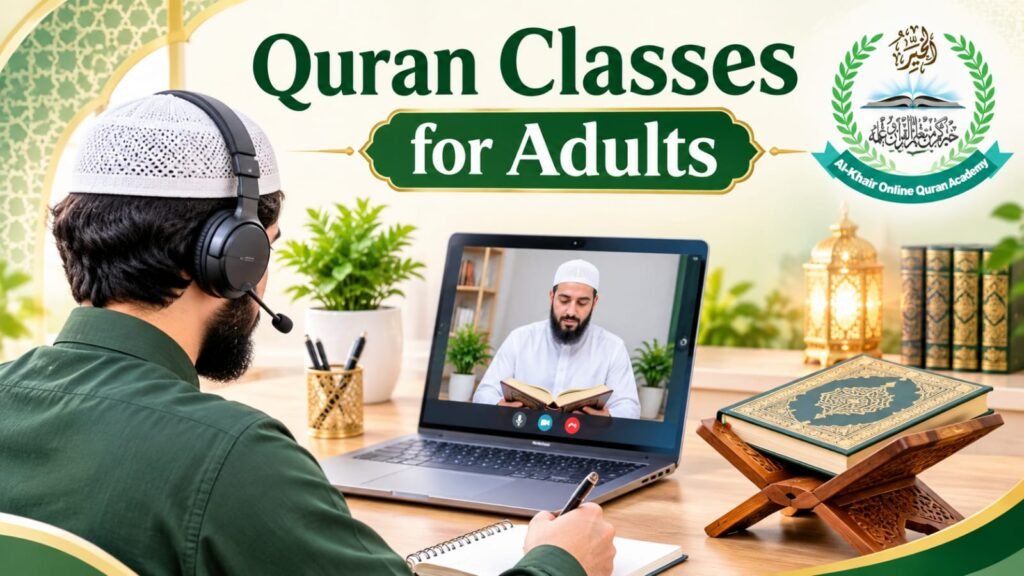
Yes. Online one-to-one lessons are well suited to beginners because the teacher can watch and hear you closely, correct you immediately and adjust the pace. You only need a stable internet connection, a device with audio and a quiet space.
How many months does it take to learn Quran?
It varies from person to person, so be wary of fixed promises. Your starting level, how many classes you take weekly and how much you practise all affect the timeline. A teacher can give you a realistic estimate after an initial assessment.
Do adults need to learn Noorani Qaida first?
If you cannot yet read Arabic letters and vowels accurately, Noorani Qaida is the recommended starting point because it builds the foundation step by step. If you already read but with mistakes, your teacher may assess you and decide whether a revision of the Qaida is needed.
Can I learn Quran with Tajweed online?
Yes. Tajweed is taught very effectively through live online lessons because the teacher can hear your recitation, point out errors and let you repeat until it improves.
How many classes per week should adults take?
There is no single answer. Many adults choose a few lessons a week to build momentum, while others with demanding schedules start with fewer and increase over time. Regular, consistent classes plus short daily practice matter more than the exact number.
Are private Quran classes better for adults?
For most adult beginners, yes. Private lessons offer personal attention, immediate correction, a pace that suits you and the privacy to learn without feeling self-conscious. Some students may still enjoy group study later on.
Can I learn Quran if I do not know Arabic?
Yes. You do not need to speak Arabic to learn to read the Quran. Reading the script and understanding the language are separate skills. You can start with reading and Tajweed, then study translation and Tafseer later if you wish.
Are online Quran classes suitable for busy professionals?
Yes. Flexible timings, no travel and short lesson blocks make online classes a practical option for people with work and family commitments. Choose a slot you can keep consistently and ask about rescheduling policies.

