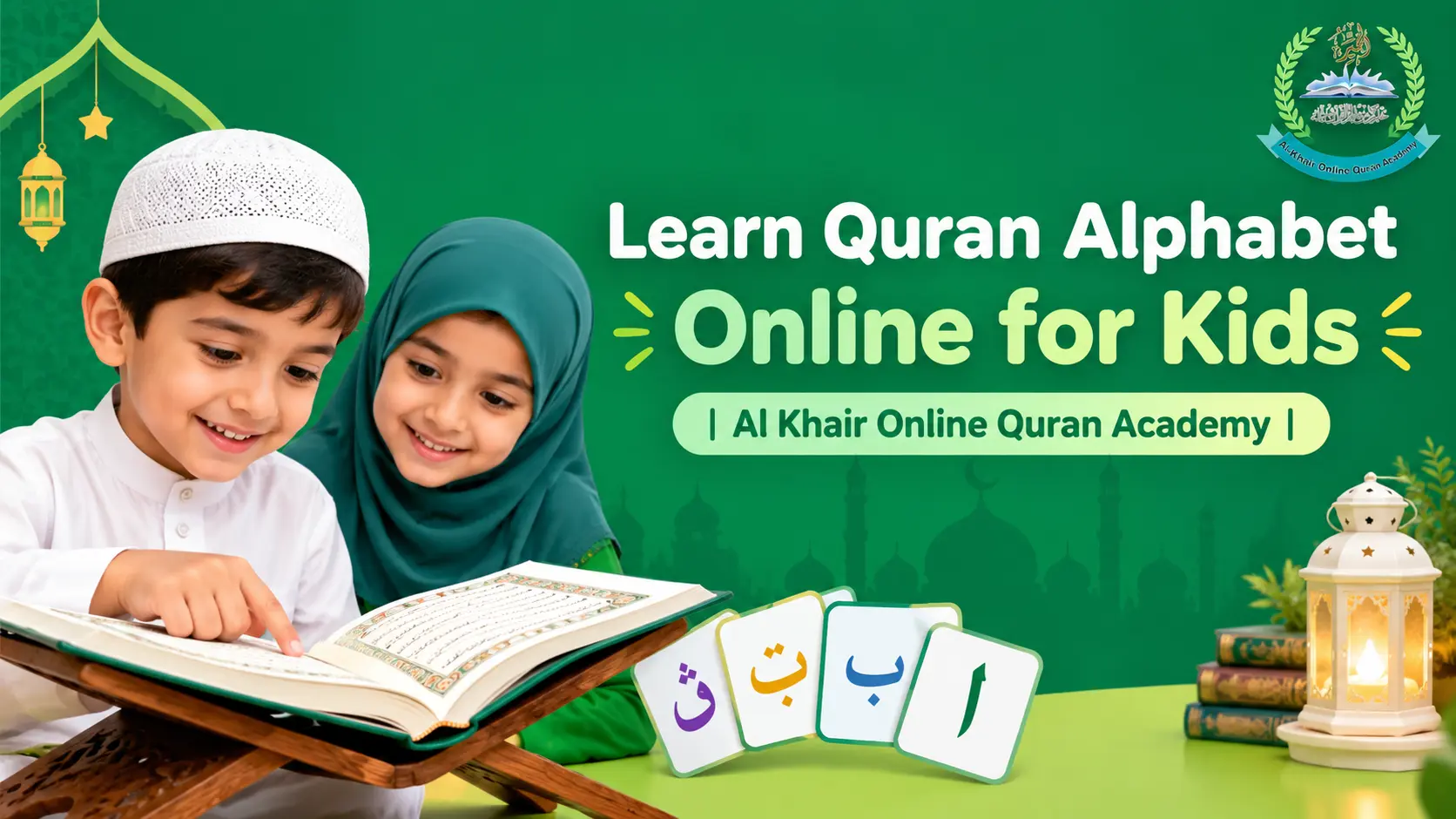
Your child mixes up “Ba” and “Ta.” He forgets the shape of “Seen” the moment he looks away from the page. You’ve tried flashcards, you’ve tried YouTube videos, and you’re still not sure if he’s actually learning to read the Quran, or just memorizing sounds without understanding them.
You’re not doing anything wrong. Most children need a structured, guided path to learn the Quran alphabet properly, not scattered resources pieced together at home. The good news: teaching a child the 28 Arabic letters, in the right order, with the right pronunciation, is a well-understood process, and it doesn’t need to feel like a struggle for either of you.
This guide walks through exactly what your child needs to learn, how the learning process actually works, and how a structured online class makes that process faster, more consistent, and far less frustrating than DIY learning at home.
What Is the Quran Alphabet and Why Should Kids Learn It First?
The Quran alphabet refers to the 28 Arabic letters, known as Huruf al-Hijaiyah, that form the foundation of every word in the Quran. Before a child can read a single verse, sound out a word, or begin Tajweed, they need to recognize these letters instantly, by shape and by sound.
This is exactly why nearly every serious Quran learning program, whether it’s Noorani Qaida, Iqra, or a modern hybrid curriculum, starts here. Skipping ahead to Quran reading without solid alphabet knowledge is one of the most common reasons children struggle later. They end up guessing at words instead of actually reading them.
Learning the Arabic alphabet also isn’t just about memorizing 28 shapes. Kids need to understand:
- Letter names and sounds, how each letter is pronounced on its own
- Letter shapes, including how a letter looks different depending on where it sits in a word
- Makharij (articulation points), where the sound is produced in the mouth or throat, which is critical for correct pronunciation
- Harakat (vowel marks), Fatha, Kasra, and Damma, which change how a letter sounds
Once these fundamentals are solid, children move naturally into Noorani Qaida, then into reading actual Quranic words, a progression that’s far smoother when the alphabet stage isn’t rushed.
What Are the 28 Arabic Letters Used in Quran Reading?
The Arabic alphabet includes letters like Alif, Baa, Taa, Thaa, Jeem, Haa, Khaa, Daal, Dhaal, Raa, Zaa, Seen, Sheen, Saad, Daad, Taa, Zaa, Ain, Ghain, Faa, Qaaf, Kaaf, Laam, Meem, Noon, Haa, Waw, and Yaa.
What trips most children up isn’t memorizing the list, it’s telling similar-looking letters apart. Baa, Taa, and Thaa, for example, share almost the same shape and differ only by the number and placement of dots. Seen and Sheen follow the same pattern. This is why a good teacher doesn’t just teach letters in order, they group visually similar letters together and drill the differences until recognition becomes automatic, rather than something the child has to stop and think about every time.
What Is the Best Age for a Child to Start Learning Quran Letters?
Most children are ready to begin learning the Quran alphabet between ages 4 and 6, once they can sit for short, focused sessions and recognize basic shapes and sounds. That said, age is a guideline, not a rule, some children are ready earlier, and others need a bit more time, and that’s completely normal.
What matters more than starting age is consistency. A 5-year-old doing 10 focused minutes a day will typically progress faster than a 7-year-old doing an unstructured hour once a week. Short, regular sessions build the kind of memory retention that sticks, this is a pattern seen consistently across structured Quran learning programs for young children.
How Kids Learn the Quran Alphabet in Our Online Classes
Teaching a child to recognize and correctly pronounce 28 Arabic letters isn’t something that happens through a single method, it requires a layered approach that engages sound, sight, and repetition together. Here’s how that process typically unfolds in a well-structured online class.
Our Step-by-Step Method: From Arabic Letters to Noorani Qaida
The learning path generally follows this sequence:
- Letter sounds before letter names, children first learn how each letter actually sounds, since this is what they’ll use when reading later.
- Letter shapes and recognition, including isolated, initial, medial, and final forms of each letter.
- Similar letters taught together, grouping look-alike letters (like Seen/Sheen or Daal/Dhaal) so children learn the distinctions clearly instead of confusing them.
- Harakat introduction, Fatha, Kasra, Damma, followed by Tanween, Sukoon, Shaddah, and Madd once the base letters are solid.
- Letter joining, learning how Arabic letters connect within a word, since most letters change shape depending on their position.
- Transition into Noorani Qaida, where letter recognition turns into actual reading practice with real Quranic word patterns.
This progression mirrors what’s taught in Noorani Qaida-based curricula, but broken into manageable stages so a young child never feels overwhelmed by too much at once.
Interactive Tools We Use, Audio, Games, and Practice Worksheets
Children retain far more when a lesson engages more than one sense. Instead of relying only on a static chart, structured online classes typically combine:
- Audio pronunciation, so the child hears the correct Makharij, not an approximation
- Visual letter cards and tracing practice, to reinforce shape recognition and early writing
- Simple recognition games and quizzes, which turn repetition into something the child actually enjoys, rather than dreads
- Worksheets for offline practice, so learning continues between live sessions
This multi-sensory approach isn’t just more engaging, it directly addresses one of the most common mistakes parents make at home: relying solely on repetition without variety, which causes kids to lose interest before the letters are fully internalized.
How We Track Your Child’s Learning Progress
Every child learns at a different pace, and parents deserve visibility into that. A well-run program typically includes regular progress updates covering:
- Which letters your child recognizes confidently vs. which still need practice
- Pronunciation accuracy and any recurring Makharij issues
- Readiness to move from alphabet recognition into Noorani Qaida
- Teacher notes after each session, so you’re never left guessing about how things are going
This kind of transparency matters, it’s what lets you reinforce practice at home in the right areas instead of guessing.
Why Parents in the USA Choose Al Khair Online Quran Academy
Finding the right fit for your child’s Quran education, from a US timezone, with a teacher who genuinely understands how to work with young learners, is harder than it sounds. Here’s what sets a well-run online Quran academy apart from a generic tutoring setup.
Qualified, Child-Friendly Quran Teachers
Not every qualified Quran teacher is equipped to teach a 5-year-old. Working with young children requires patience, an understanding of short attention spans, and the ability to make correction feel encouraging rather than critical. At Al Khair Online Quran Academy, teachers are selected specifically for their ability to connect with children, using positive reinforcement, gentle correction, and a calm, supportive learning environment where kids feel safe making mistakes.
| DIY Learning at Home | Al Khair Online Quran Academy | |
| Pronunciation accuracy | Depends on parent’s own Arabic knowledge | Corrected live by a trained teacher, letter by letter |
| Structure | Often inconsistent or self-paced | Follows a proven step-by-step curriculum |
| Engagement | Limited to videos/apps | Live interaction, games, and real-time feedback |
| Progress tracking | Informal, easy to lose track of | Structured updates after each session |
| Consistency | Depends entirely on parent’s schedule | Fixed, flexible class slots that build routine |
Flexible Class Timings for Busy US Families
Between school, activities, and everyday life, finding a consistent daily slot can be genuinely difficult. Classes are scheduled around US time zones with flexible morning, afternoon, and evening options, so learning fits into your family’s routine instead of disrupting it. One-to-one and small-group formats are both available, depending on what suits your child’s learning style best.
Book a Free Trial Class Today
The easiest way to see if this approach is right for your child is to try it. A free trial class lets you sit in, watch how the teacher interacts with your child, and see the teaching method in action, no commitment required. If it feels like the right fit, enrolling is simple, with flexible scheduling built around your family’s needs.
Frequently Asked Questions About Learning the Quran Alphabet Online
How Long Does It Take for a Child to Learn the Quran Alphabet?
Most children can recognize and pronounce all 28 Arabic letters within 4 to 8 weeks of consistent practice, assuming short daily sessions of 10–15 minutes. Moving into Noorani Qaida and early reading typically follows a few weeks after that, though pace varies by child. What matters most isn’t speed, it’s building recognition that’s automatic, not something your child has to pause and think through every time.
Can Parents Who Don’t Speak Arabic Help Their Child Learn?
Yes, and this is one of the most common concerns parents raise. You don’t need to speak Arabic to support your child’s learning at home. A qualified teacher handles the actual instruction and pronunciation correction during class; your role at home is mainly encouragement, consistency, and light repetition practice using the worksheets or flashcards provided. Many parents actually learn alongside their child in the process, which tends to strengthen the experience for both.
What Is the Best Way to Teach Similar-Looking Arabic Letters?
Teach them side by side rather than in isolation. Letters like Baa, Taa, and Thaa, or Seen and Sheen, are far easier to tell apart when a child compares them directly and practices the distinction repeatedly, rather than learning each one separately and hoping the difference sticks later.
How Long Should Daily Quran Alphabet Practice Sessions Be?
For young children, 10 to 15 minutes of focused practice is far more effective than a long, unstructured session. Short bursts prevent fatigue and frustration, keep the child’s attention sharp, and are easier to sustain consistently, which is ultimately what determines how quickly a child progresses.
Give Your Child a Real Foundation in Quran Reading
Learning the Quran alphabet is the single most important first step in your child’s Quran journey, get this stage right, and everything that follows, from Noorani Qaida to fluent Quran reading, becomes significantly easier.
At Al Khair Online Quran Academy, your child learns from a qualified, child-friendly teacher, using a structured, proven method, with real progress you can actually see. Book your child’s free trial class today and see the difference a properly guided start makes.

