
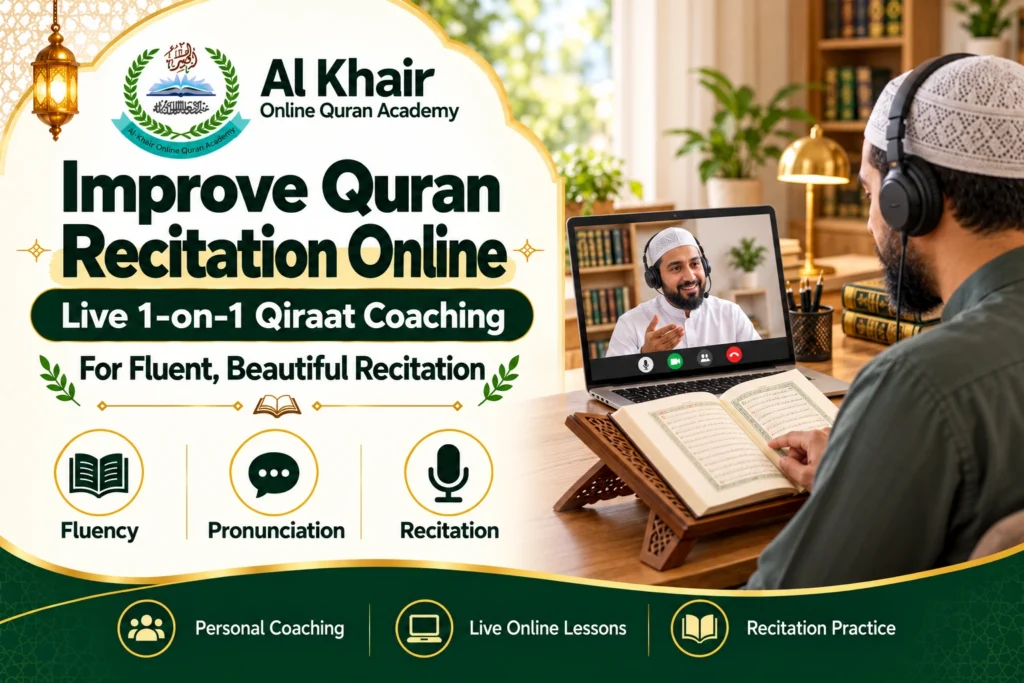
You can read the Quran. You know the letters, you know most of the rules, and you can get through a page without stopping. But when you listen to a recording of yourself, something feels flat. The rhythm is uneven, the elongations wander, and the beauty you hear in your favorite reciters never quite reaches your own voice.
That gap between reading correctly and reciting beautifully is where many adults in the USA get stuck. Videos explain rules, but they cannot hear you. Local classes often focus on beginners. And without someone listening closely, small habits settle in and stay for years.
The good news is that you can improve Quran recitation online with a teacher who listens to every ayah and coaches you live. At Al-Khair Online Quran Academy, our Qiraat improvement course is designed for students who already read and now want polished, confident, and beautiful recitation.
This guide explains what separates good recitation from great recitation, the most common habits that hold readers back, and a practical plan to improve week by week.
Why Should You Work on the Beauty of Your Recitation?
Allah instructs the Prophet ﷺ in the Quran to recite the Quran properly in a measured way (Surah Al-Muzzammil, 73:4). The word used, tartil, describes recitation that is calm, clear, and well-paced, giving every letter its due.
The Prophet ﷺ also encouraged believers to beautify the Quran with their voices (Sunan Abi Dawud 1468). Beautiful recitation is not about showing off. It is about honoring the words of Allah and reciting them in a way that moves your own heart and the hearts of those who listen.
When your recitation improves, you will notice:
- More focus in salah. Measured recitation slows you down and helps you reflect.
- More confidence. You can lead prayer at home or recite at gatherings without anxiety.
- Better retention. A steady rhythm makes memorized passages easier to recall.
- A stronger example for your children. Kids imitate the recitation they hear most.
What Is the Difference Between Correct and Beautiful Recitation?
Correct recitation means no mistakes in letters, vowels, or core Tajweed rules. Beautiful recitation builds on that foundation and adds polish. Both matter, and one leads to the other.
| Element | Correct Recitation | Beautiful Recitation |
|---|---|---|
| Letters | Every letter from its right articulation point | Every letter clear, crisp, and effortless |
| Elongation (madd) | Counts are respected | Counts are steady and consistent across the page |
| Ghunnah | Present where required | Smooth, even, and the right length every time |
| Pace | Not rushed | Calm, measured rhythm that fits the meaning |
| Stopping and starting | Stops at allowed places | Stops chosen to keep the meaning clear |
| Voice | Audible | Controlled breath, steady tone, natural melody |
If you are still unsure about the core rules, polish will not hold. In that case, start with our live Tajweed practice classes and move into recitation coaching once the rules feel automatic.
What Common Habits Hold Back Your Quran Recitation?
Most readers who want to improve share a few familiar habits. The first step to fixing them is noticing them.
Rushing Through Familiar Surahs
Surahs we recite daily, like Al-Fatiha and the short surahs of Juz Amma, are often the ones we rush the most. Speed blurs letters together and shortens elongations. Your teacher will often begin here, because improving the passages you recite most changes your daily prayers immediately.
Uneven Madd Counts
You may hold a natural madd for two counts in one line and three in the next. Uneven counts break the rhythm of recitation. Coaching focuses on keeping each type of madd the same length from the start of a page to the end.
Weak Heavy Letters and Throat Letters
Letters such as ص, ض, ط, and ظ need fullness, while throat letters like ع and ح need precise placement. Many readers soften these, especially if they grew up speaking English. Small daily drills make a big difference.
Running Out of Breath
Stopping in the middle of a phrase because you ran out of air can change the meaning. Breath control is a learnable skill. Your teacher will show you where to pause, how to breathe quietly, and how to start again in the right place.
Copying a Reciter’s Style Without the Basics
Imitating a beloved Qari is a great way to learn, but copying melody before mastering letters can hide mistakes. Good coaching keeps accuracy first and adds style on top of it.
How Do Online Qiraat Improvement Classes Work?
Each session is live and one-to-one, so the entire class focuses on your voice. A typical lesson includes:
- Warm-up recitation. You recite a familiar passage so the teacher can hear your current rhythm.
- Targeted correction. The teacher picks one or two habits to work on, not ten at once.
- Model and repeat. The teacher recites a line, and you repeat it until it matches in clarity and pace.
- Full passage practice. You apply the improvement across a longer section.
- Home practice plan. A short daily exercise, often recording yourself and comparing.
Because the teacher hears you in real time, problems are caught immediately, before they become fixed habits.
How Long Does It Take to Improve Your Recitation?
Improvement often comes faster than students expect, because they already have the foundation. With consistent practice, here is a realistic picture:
| Timeframe | What Usually Improves |
|---|---|
| First 2 to 4 weeks | Pace slows down, short surahs sound clearer, rushing habits fade |
| 1 to 3 months | Madd and ghunnah become consistent, heavy letters strengthen |
| 3 to 6 months | Breath control and stopping improve, full pages flow smoothly |
| 6 months and beyond | Confident, polished recitation suitable for leading prayer |
How Can You Practice Recitation at Home Between Classes?
Your daily practice matters as much as your class time. These habits help most students:
- Record yourself weekly. Listening back is the fastest way to hear your own habits.
- Listen to one reciter regularly. Choose a clear, measured reciter and listen to the passage you are studying.
- Practice slowly first. Recite at half speed, then build up while keeping accuracy.
- Focus on one page. Polishing one page well teaches more than rushing through ten.
- Recite aloud in prayer. Apply what you learn in your sunnah and night prayers.
How Much Does a Qiraat Improvement Course Cost?
Our monthly plans are simple, with no long-term contract, and you can compare them on our monthly pricing plans page:
| Plan | Schedule | Monthly Fee |
|---|---|---|
| Special Weekend | 30 minutes, Saturday and Sunday | $30 |
| Starter | 30 minutes, 3 days a week | $40 |
| Standard | 30 minutes, 5 days a week | $60 |
Every new student starts with 3 free trial days, so you can hear your teacher’s coaching style before choosing a plan.
Frequently Asked Questions About Improving Quran Recitation Online
How can I improve my Quran recitation quickly?
Slow down first. Most improvement comes from reciting at a calm, measured pace with a teacher who corrects you live. Focus on one or two habits at a time, record yourself every week, and practice the surahs you recite most often in prayer. Small, steady changes add up faster than rushing.
Can I improve my recitation without learning all the Tajweed rules again?
If you already know the core rules, you do not need to start over. A recitation coach builds on what you know, refining pace, consistency, and clarity. If your teacher hears gaps in the basics, they will review only those specific rules rather than repeating the whole course.
What is the difference between Qiraat and Tajweed?
Tajweed is the set of rules for pronouncing the Quran correctly. Qiraat refers to the recognized methods of reciting the Quran passed down through chains of transmission. In our Qiraat improvement course, the focus is on refining your recitation in Hafs ‘an ‘Asim so it becomes fluent, accurate, and beautiful.
Do I need a good voice to recite the Quran beautifully?
No. Beautiful recitation comes mainly from accuracy, calm pace, steady elongations, and good breath control, not from having a naturally strong voice. With practice, every voice becomes clearer and more confident. The Prophet ﷺ encouraged believers to beautify the Quran with their own voices.
Is it good to imitate a famous Qari?
Yes, as long as accuracy comes first. Listening to a clear reciter helps you absorb rhythm and pacing. But copying melody before your letters and rules are correct can hide mistakes. A teacher helps you learn from a reciter’s style while keeping your recitation accurate.
Can adults improve their recitation online?
Yes. Adults often improve quickly because they already read and can apply feedback consciously. Live one-to-one sessions let your teacher hear every letter and correct you immediately, while flexible US timings make it easy to keep a steady routine around work and family.
How often should I attend recitation classes?
Three sessions a week is a strong starting point for most adults. Students preparing to lead prayer or aiming for faster progress often choose five days a week. Consistency matters more than session length, so pick a schedule you can keep every week.
Let Your Recitation Reflect the Beauty of the Quran
You have already done the hard work of learning to read. Now you can take the next step and recite with the calm, measured beauty the Quran deserves. When you improve Quran recitation online with a patient teacher, every week brings clearer letters, steadier rhythm, and more confidence in your own voice.
Hear the difference for yourself. Start your 3 free trial days of recitation coaching with Al-Khair Online Quran Academy and recite your first polished page this week.

