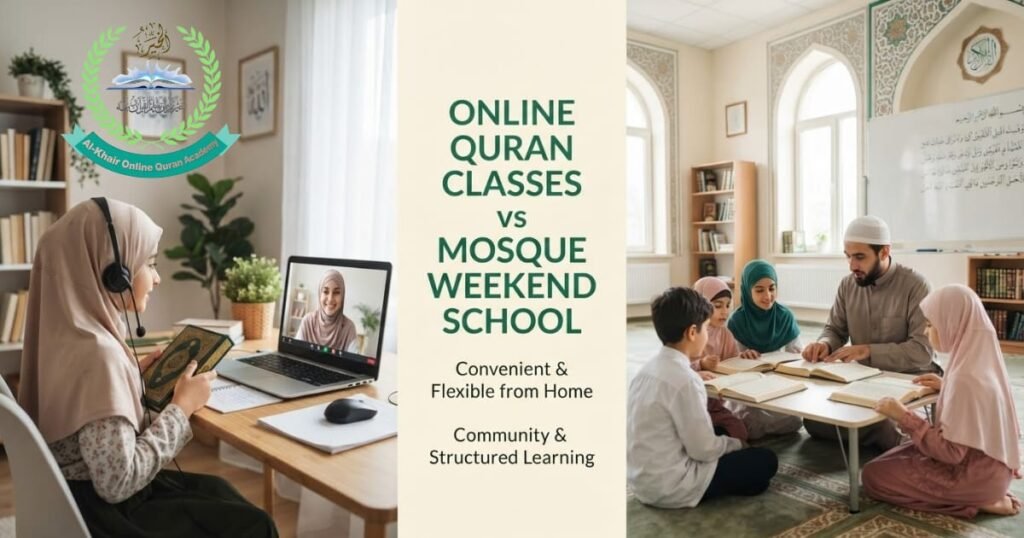
Imagine a Saturday morning in a typical Muslim household in the United States. One parent is thinking about the drive to the Islamic center, the other is juggling soccer practice, homework, and a work shift. Both want their child to learn the Quran with proper recitation and a real love for it. But which route makes more sense: a local mosque weekend school or lessons from home through a screen?
The question of online Quran classes vs mosque classes does not have one answer that fits every family. Both options can support strong Quran learning. They differ in schedule, teaching format, individual attention, and the kind of social experience they offer. This guide compares them honestly, including the limits of each, so you can decide what suits your child, or whether a mix of both might work best.
What Are Online Quran Classes?
Online Quran classes are lessons delivered live over a video platform such as Zoom or a similar tool. The student sits at home (or another suitable place) with a laptop or tablet and recites to a teacher in real time.
Depending on the academy, online lessons may include:
- Live lessons through video: the teacher listens, corrects, and demonstrates.
- Learning from home: no commute required.
- One-to-one or group formats: some academies focus on private lessons, others run small groups.
- Different subjects: Noorani Qaida, Quran reading, Tajweed, or Hifz (memorization).
- Flexible scheduling, where the academy offers it.
Not every online academy works the same way. Teacher qualifications, lesson length, class size, and curriculum can vary widely, so it is worth asking specific questions before enrolling.
What Is a Mosque Weekend Islamic School?
A mosque weekend school (often called a weekend Islamic school or Sunday school) is an in-person program run by a mosque or Islamic center, usually on Saturdays or Sundays. Children attend a classroom with a teacher and other students.
Typical offerings may include:
- In-person Quran learning: Qaida, reading, and sometimes memorization.
- Islamic studies: such as seerah, fiqh basics, duas, and Islamic manners.
- Group learning: children study alongside classmates.
- Interaction with other Muslim children: friendships and a sense of belonging.
- Community participation: events, Ramadan programs, and Eid activities.
- A structured weekend schedule.
Programs differ from one mosque to another. Some have well-organized curricula and experienced teachers; others are smaller, volunteer-run, or limited in the courses they offer. Not every weekend school provides the same quality of Quran instruction.
Online Quran Classes vs Mosque Classes – Key Differences
Here is a side-by-side overview. Keep in mind that individual academies and mosques may differ from these general patterns.
| Factor | Online Quran Classes | Mosque Weekend School |
| Learning location | Home or another suitable location | Mosque or Islamic center |
| Class format | One-to-one or online group | Usually in-person group classes |
| Schedule | May offer flexible timings | Often follows a fixed weekend schedule |
| Teacher attention | Individual attention may be available | Depends on class size and teacher |
| Social interaction | Online interaction | In-person interaction with peers |
| Travel | Usually no travel required | Family may need to travel |
| Learning environment | Home learning space | Mosque or Islamic center |
| Course options | Depends on the academy | Depends on the mosque program |
| Parent involvement | May be needed, especially for younger children | Parents may support attendance and revision |
Neither column is automatically “better.” The right fit depends on what your child needs and what is available to you.
Benefits of Online Quran Classes for US Families
For many families, the advantages of online learning are practical.
Flexible Scheduling
Some online academies offer class times that fit around school, work, and family routines. That can matter a lot for households with several children or parents who work non-traditional hours.
Learning from Home
Online lessons can remove the commute. This may help families who live far from a mosque that offers Quran classes, or those in areas with limited local options.
Individual Attention
In a one-to-one lesson, a teacher can focus on a single student’s recitation, pronunciation, and mistakes. A child who needs extra repetition can get it without slowing down a class.
Access to Different Teachers
Families may have a wider choice of teachers than what is available locally, including the option of a male or female teacher, depending on the academy.
Personalized Learning Pace
Individual lessons can be adjusted to the learner’s current level and goals. A beginner can start with letters, while a more advanced student can work on Tajweed refinement or memorization.
These benefits depend on the academy and the teacher. Online learning also requires a stable internet connection and, for younger children, some parental help.
Benefits of Mosque Weekend Schools
Mosque schools offer strengths that online lessons cannot fully replicate.
Muslim Community and Social Interaction
Children may build friendships with other Muslim students and feel more connected to their local community. For kids growing up as a minority in their school environment, this can be especially meaningful.
In-Person Learning Environment
Some children focus better when they are physically present in a classroom with a teacher and classmates. For them, a screen can feel distant or distracting.
Islamic Studies and Community Activities
Some weekend schools include Islamic studies, group activities, and community events in addition to Quran lessons. This can give children a broader sense of Islamic education and identity.
Routine and Structure
A fixed weekend schedule may help some families build a regular learning habit. When Saturday morning is “Islamic school time,” it can become a normal part of the week.
Of course, not every mosque school offers all of these features. Some are excellent; others may have limited resources, large classes, or fewer qualified teachers.
Which Option Provides More Individual Attention?
Individual attention depends on class size, teaching method, and the student’s needs.
A one-to-one online lesson may allow focused recitation practice, since the teacher’s attention is on one student for the whole session. A mosque class with many students may offer less time per child for recitation, although a small class with a skilled teacher can still give good individual feedback. Group classes have their own strengths: children can learn from hearing peers, feel motivated by friendly competition, and see that others are learning too.
It would be inaccurate to say online classes always provide better teaching, or that mosque classes always lack attention. A great teacher in either setting makes a big difference.
Which Option Is Better for Children?
The more useful question is: which option is better for your child? Consider:
- Age and attention span: Younger children may find long video lessons tiring; others thrive with a patient one-to-one teacher.
- Quran reading level: Beginners, intermediate readers, and Hifz students have different needs.
- Learning preferences: Some children learn best in groups; others do better with quiet, focused attention.
- Need for individual correction: A child struggling with pronunciation may benefit from more personal feedback.
- Social and community needs: Some kids need peer connection and community involvement.
- Family schedule: The best program is one the family can attend consistently.
- Availability of qualified teachers: Quality matters more than format.
Some children thrive in a mosque classroom; others benefit from individual online lessons. Many parents only discover which suits their child by trying.
Weekend Islamic School vs Online Quran Classes – What About Busy Families?
When parents compare weekend Islamic school vs online learning, scheduling is often the deciding factor. Common situations include:
- Parents working during the week: Weekend school may fit, or weekday evening online lessons may be easier.
- Children with school and extracurriculars: Weekends can already be full with sports and activities.
- Families living far from a mosque: A long drive each weekend can be hard to sustain.
- Families managing multiple children: Coordinating several schedules may favor flexible timings.
- Parents who prefer a consistent weekly routine: A fixed weekend program can offer that predictability.
Try to look at the whole week, not just one factor. A program that looks convenient on paper but leaves your child exhausted, or makes you miss classes regularly, will not serve them well. Consistency matters more than convenience alone.
Can Children Attend Both Online Quran Classes and Mosque School?
Yes, many families combine the two. For example:
- Mosque weekend school for community connection, Islamic studies, and group activities.
- Online Quran classes for additional reading practice or individual Tajweed guidance.
This can work well when each option has a clear purpose. The key is to keep it manageable. Too many classes can cause fatigue and make a child resist Quran learning. Start with a realistic plan, watch how your child responds, and adjust.
How to Choose the Right Quran Learning Option
Use these questions as a practical checklist:
- What Quran skills does my child need to learn? (Qaida, fluent reading, Tajweed, memorization)
- Does my child need individual attention?
- Is a suitable mosque school available nearby?
- Does the schedule fit our family routine?
- What are the teacher’s qualifications and teaching methods?
- How are students’ progress and mistakes addressed?
- Does my child feel comfortable in the learning environment?
- Can we try a class before making a commitment?
If possible, visit the mosque school or sit in on a class, and try a trial lesson online. Seeing your child in each setting tells you more than any brochure.
Online Quran Classes USA – What Parents Should Consider
If you decide to explore online Quran classes USA families can rely on, look carefully at the details:
- US time zones: Make sure lesson times are clear and convenient for your region.
- School schedules: After-school and weekend slots may be easier.
- Teacher availability: Ask whether your child can keep a consistent teacher.
- Lesson frequency: More frequent short lessons may suit some children better than fewer long ones.
- Parent-teacher communication: You should be able to ask questions and receive feedback.
- Internet and audio quality: Clear audio is essential for correcting pronunciation.
- Course suitability: Check that the academy offers the right level, whether Qaida, Tajweed, or Hifz.
- Transparent fees and policies: Ask about costs, rescheduling, and cancellation before you start.
Compare actual teaching quality and suitability rather than relying only on advertisements. A trial class is the best way to do that.
Frequently Asked Questions
1. Are online Quran classes better than mosque classes?
Not universally. Online classes may offer flexibility and one-to-one attention, while mosque classes offer in-person community and structure. The better option depends on your child, your schedule, and the quality of the teacher.
2. Can children learn Quran effectively online?
Many can, particularly with a qualified teacher, live correction, regular practice, and parental support. Some children, however, focus better in a physical classroom.
3. What are the benefits of mosque weekend schools?
They can provide community connection, friendships with other Muslim children, in-person learning, Islamic studies, and a regular weekend routine. Offerings vary by mosque.
4. Do online Quran classes provide individual attention?
One-to-one online lessons can, since the teacher focuses on a single student. Group online classes may offer less. Ask the academy about its format.
5. Is a weekend Islamic school necessary for every child?
No. It is a valuable option for many families, but some children learn well through other formats, and some families have no suitable school nearby. Others combine more than one approach.
6. Can my child attend both online Quran classes and mosque school?
Yes, if the schedule is manageable. Many families use the mosque for community and Islamic studies and online lessons for focused recitation. Watch for fatigue.
7. How do I choose the best Quran learning option for my child?
Consider your child’s level, attention span, need for individual feedback, social needs, family schedule, and teacher quality. Try a trial class or visit the mosque program before deciding.
8. Are online Quran classes suitable for families in the USA?
They can be, especially for families with busy schedules or limited local options. Check time zones, class timings, teacher communication, and internet quality to make sure the arrangement works for you.
Where Al-Khair Online Quran Academy Fits In
If online learning looks like it could suit your family, Al-Khair Online Quran Academy is one option to consider. The academy offers one-to-one live Quran lessons, male and female teacher options, flexible class timings, and personalized learning designed around each student’s level and goals.
Online learning is not a replacement for everything a mosque community offers, and it is not the right fit for every child. For some families it works as a main option; for others it complements a local weekend school. The best way to judge is to try it, which is why the academy offers three free trial classes.
Book your three free trial classes and see whether the online teaching style suits your child.
Final Thoughts – Choose What Works Best for Your Family
When weighing online Quran classes vs mosque classes, remember what each does best. Online lessons may offer flexibility, no commute, and focused one-to-one attention. Mosque weekend schools offer in-person community, peer interaction, and often broader Islamic studies. Both can support Quran education when the teaching is suitable, the student participates regularly, and the family supports consistent learning.
There is no single right answer. Consider your child’s needs, the quality of the teacher, your schedule, and your community preferences. Try before you commit, and be willing to adjust as your child grows. The best Quran learning option is the one your child attends consistently, feels comfortable in, and keeps growing through.

