Your child is ready to start learning the Quran, and you want them to read it correctly and enjoy it. Then comes a practical question: should they have a teacher all to themselves, or learn alongside other children in a group? Many parents in the United States find themselves stuck between the two, especially when the options look similar online but differ in price, pace, and experience.
Both formats can support good Quran learning. They simply offer different experiences. This guide on one-on-one vs group Quran classes compares them fairly, covering the strengths and limits of each, so you can choose the format that suits your child, your family, and your budget.
What Are One-on-One Quran Classes?
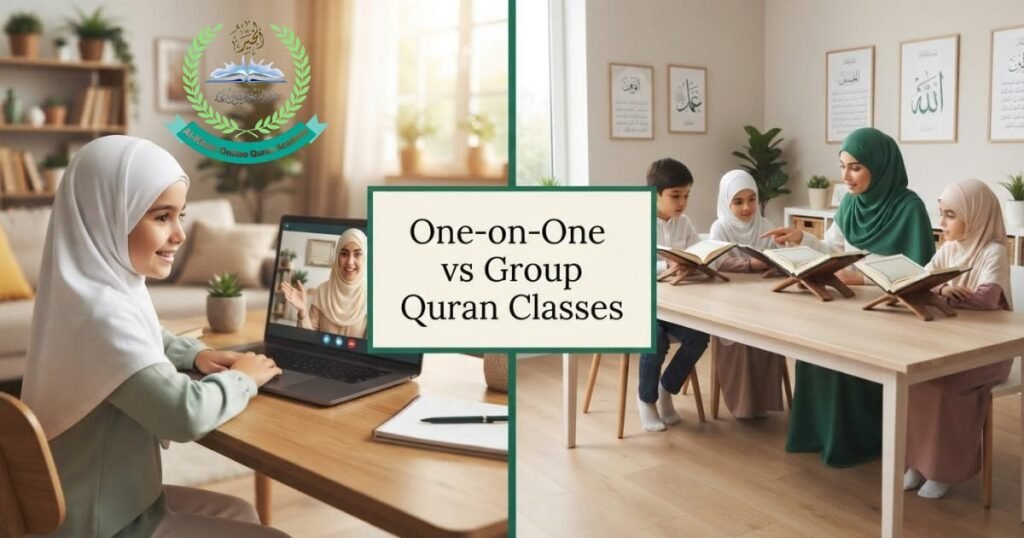
In a one-on-one class, a teacher works with a single student for the whole lesson. The format may also be called private or one-to-one Quran lessons, and it may be offered online or in person, depending on the academy or tutor.
Typical features include:
- Individual recitation practice: the student recites for most of the lesson.
- Teacher attention on one learner: nothing competes for the teacher’s focus.
- A personalized pace: the lesson can slow down or move ahead as needed.
- Direct correction of mistakes: the teacher can fix errors immediately.
- Goals suited to the student’s level: whether that is letter recognition, fluent reading, Tajweed, or memorization.
How this plays out depends on the teacher. A private lesson with a patient, well-prepared teacher is very different from one with a rushed or unstructured approach.
What Are Group Quran Classes?
Group Quran classes bring several students together with one teacher in the same session. They may take place in a mosque, an Islamic school, or online.
Common features include:
- A shared learning environment: students study the same material at the same time.
- Group recitation or practice: children may read together or take turns.
- Learning alongside other students: hearing classmates can be motivating.
- A teacher-led structure: lessons often follow a set plan for the whole class.
- Opportunities for peer interaction: children can make friends with other Muslim students.
Group size and teaching methods vary widely. A group of three with a skilled teacher is a different experience from a crowded class of twenty.
One-on-One vs Group Quran Classes – Key Differences
The table below shows general patterns. Individual academies and tutors may differ.
| Factor | One-on-One Quran Classes | Group Quran Classes |
| Class format | One teacher and one student | One teacher and multiple students |
| Individual attention | Teacher focuses on one learner | Attention is shared |
| Learning pace | Can be adjusted to the student | Often follows a group lesson pace |
| Recitation correction | Direct individual feedback | Depends on class size and lesson structure |
| Social interaction | Limited peer interaction | More opportunities to interact with classmates |
| Scheduling | May offer more scheduling flexibility | Often follows a fixed class schedule |
| Student confidence | May suit learners who prefer private practice | May suit learners who enjoy learning with others |
| Fees | Often higher per lesson | May be more affordable per student |
| Learning goals | Can be personalized | Often follows shared learning goals |
No format is automatically superior. What matters is how well the format matches the learner.
Benefits of One-on-One Quran Classes
Individual Attention
The teacher can concentrate on one student’s recitation, pronunciation, and specific difficulties. A mistake that might slip by in a crowded class is more likely to be noticed.
Personalized Learning Pace
A teacher may spend extra time on a hard lesson or move on when the student is ready. A child does not need to wait for others or struggle to keep up.
Direct Recitation Correction
Individual lessons can provide focused feedback on Quran reading and Tajweed. The student recites, the teacher listens closely, and corrections happen right away.
Suitable for Different Learning Levels
Private lessons may be helpful for beginners, for students with specific goals, and for learners who need extra practice. Adults who feel shy about reading in front of others often prefer this setting too.
Flexible Scheduling
Some private tutors and academies may offer more scheduling options, which can help families with busy school, work, and activity calendars.
These benefits depend on the teacher or academy. A private lesson only delivers its potential when the teacher uses the time well.
Benefits of Group Quran Classes
Learning with Other Students
Many children enjoy learning alongside peers. Seeing others read, ask questions, and make progress can be encouraging, and a little friendly motivation goes a long way.
Social Interaction
Group classes can offer chances to build friendships and connect with other Muslim students, which matters to many families.
Shared Learning Experience
Students may benefit from listening to classmates recite, hearing the teacher correct others, and joining group activities.
More Affordable Options
Group classes may cost less per student, depending on the academy’s fee structure.
Structured Group Routine
A regular group schedule can help some learners stay consistent, since the class meets at a set time with set expectations.
Not every group class is inexpensive, and not every one delivers the same social experience. A very large group may offer little personal feedback.
Private Quran Tutor vs Group – Which Is Better for Children?
When parents weigh a private Quran tutor vs group lessons, the best answer depends on the child. Consider:
- Age and attention span: Younger children may focus better with a patient teacher in a short, personal lesson, though some enjoy the energy of a group.
- Quran reading level: Beginners and advanced readers have different needs.
- Learning confidence: A shy child may open up privately, while a more outgoing child may thrive in a group.
- Need for individual correction: Persistent pronunciation difficulties may call for more one-to-one feedback.
- Ability to learn in a group: Some children get distracted or lost in a group.
- Family schedule: The format must fit the family’s week.
- Budget: Cost is a legitimate factor.
- Teacher’s teaching style: A skilled, warm teacher matters more than the format.
Some children benefit most from private lessons, while others enjoy group learning. Some families even try one and then switch. No single format is best for every child.
Which Class Format Is Better for Quran Beginners?
Beginners usually need help with:
- Arabic letter recognition
- Noorani Qaida, the foundational course that teaches letters, sounds, and how they connect
- Basic pronunciation
- Quran reading fluency
- Introductory Tajweed
Private lessons may provide focused support, since the teacher can adjust to the child’s exact level and revisit the basics as often as needed. A well-organized group class can also help beginners succeed, especially when the group is small, the teacher gives each child time to read, and the class moves at a comfortable pace.
The key is assessment. A good teacher should hear the student read and then recommend a format and starting point, rather than placing everyone in the same plan.
One-on-One or Group Quran Classes for Tajweed?
Tajweed means reciting the Quran with proper pronunciation and rules. It depends heavily on listening and correction. Important areas include:
- Makharij al-Huruf: the points of articulation, meaning where each Arabic letter is produced in the mouth or throat.
- Correct pronunciation of Arabic letters, especially those that have no close English equivalent.
- Basic Tajweed rules, such as how long to stretch certain sounds.
- Regular recitation practice, because Tajweed develops through repetition.
- Teacher feedback, so mistakes do not become habits.
How well Tajweed is taught depends on the teacher’s knowledge, the lesson structure, and how often students actually recite. One-on-one lessons can give each student more recitation time. Group classes can also teach Tajweed well, particularly when the class is small and every student gets individual feedback. Group size matters more than the label.
Are One-on-One Quran Classes Worth the Cost?
Private lessons often cost more per lesson, so it is fair to ask whether they are worth it. Rather than guess at prices, think about value:
- Teacher attention: how much of the lesson is spent on your child’s recitation?
- Lesson duration: is the time long enough to be useful but short enough for your child’s focus?
- Your child’s learning needs: does your child need individual correction or a custom pace?
- Progress and feedback: do you see improvement and receive clear updates?
- Weekly lesson frequency: consistent, regular lessons often matter more than one long session.
- Family budget: a plan you can sustain is better than one you must drop.
The lowest price is not always the best value, but a more expensive private lesson is not automatically better either. A well-run small group may serve one child perfectly, while another child may gain a lot from private lessons. Compare what you receive, not just what you pay.
Online Quran Classes USA – Choosing the Right Format
If you are exploring online Quran classes USA families can choose from, look at the details that affect day-to-day learning:
- US time zones: confirm that class times work where you live.
- School and family schedules: weekday evenings and weekends are common choices, but they vary.
- Teacher availability: ask whether your child can keep the same teacher.
- Private or group options: find out which formats the academy offers and whether you can switch.
- Online communication: make sure you can reach the teacher or academy with questions.
- Internet and audio quality: clear sound is essential for correcting pronunciation.
- Transparent fees and policies: understand costs, rescheduling, and cancellation up front.
Before enrolling, compare the actual teaching method and class structure, not just the marketing. A trial class makes this much easier.
Questions Parents Should Ask Before Enrolling
Use this list when speaking with any academy or tutor:
- Is the class private or group-based?
- How many students are in a group?
- How much time does each student get to recite?
- How does the teacher correct pronunciation?
- Can the lesson pace be adjusted?
- Are classes suitable for my child’s current level?
- Can I choose a male or female teacher?
- Is there a trial class?
- What are the fees and rescheduling policies?
- How will parents receive progress updates?
Clear, specific answers are a good sign. Vague answers are worth noting.
Frequently Asked Questions
1. Are one-on-one Quran classes better than group classes?
Not always. One-on-one lessons may give more individual attention and flexibility, while group classes may offer peer interaction and lower cost. The better option depends on your child, the teacher, and your budget.
2. What is the difference between private and group Quran lessons?
Private lessons involve one teacher and one student, so attention and pace can be personalized. Group lessons involve several students, so attention is shared and the pace is usually set for the group.
3. Are private Quran classes worth it?
They can be, especially for learners who need individual correction or a custom pace. Judge value by teacher attention, progress, and feedback, not just price.
4. Can beginners learn Quran in group classes?
Yes, particularly in a small, well-organized group where each student gets time to recite. Some beginners, however, may need more individual support at first.
5. Which Quran class format is better for children?
It depends on the child’s age, attention span, confidence, and level. Some children thrive privately; others enjoy learning with peers. A trial lesson can help you see which suits yours.
6. Do group Quran classes teach Tajweed?
Many do. Tajweed instruction depends on the teacher’s knowledge, class size, and how much each student gets to recite and receive feedback.
7. Are one-on-one online Quran classes more expensive?
Often they cost more per lesson than group classes, but fees vary by academy. Ask about lesson length, frequency, and policies so you can compare fairly.
8. How do I choose the right Quran class for my child?
Consider your child’s level, learning style, schedule, and your budget. Ask the questions listed above, then try a trial class before committing.
Where Al-Khair Online Quran Academy Fits In
If one-to-one online learning sounds like a good match, Al-Khair Online Quran Academy is one option to consider. The academy offers one-to-one live Quran lessons, male and female teacher options, flexible class timings, and personalized learning shaped around each student’s level and goals.
Private lessons are not automatically better than group classes, and the right choice depends on your child. The simplest way to find out is to try it, which is why Al-Khair offers three free trial classes.
Book your three free trial classes and see whether the one-to-one teaching format suits your child.
Final Thoughts – Choose the Quran Class That Fits Your Needs
In the comparison of one-on-one vs group Quran classes, private lessons tend to offer focused attention, a flexible pace, and direct correction, while group classes tend to offer peer learning, social connection, and often a lower cost. Both formats can be effective when the teacher is qualified, the student receives suitable guidance, and learning is consistent.
Think about your child’s learning style, Quran reading level, schedule, and your budget. Ask good questions, try a trial class, and stay open to adjusting. The best format is the one your child will attend regularly, feel comfortable in, and keep learning from.

