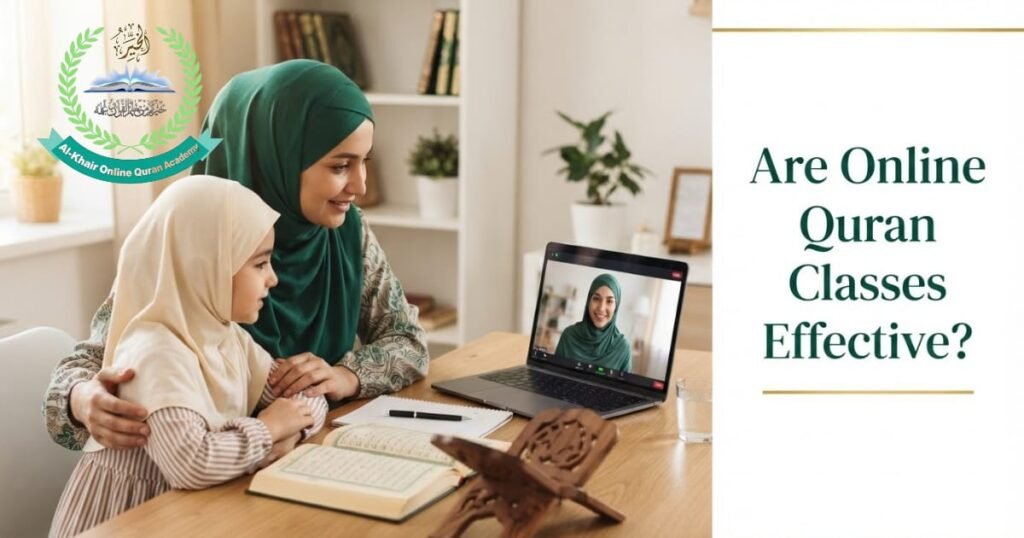
Most Muslim parents in the United States share the same hope: they want their children to read the Quran correctly, love it, and keep a connection with it for life. But when the nearest qualified teacher is an hour away, or weekday schedules leave no room for a commute, many families turn to a laptop or tablet and wonder, are online Quran classes effective, or is nothing quite the same as sitting beside a teacher?
The honest answer is that it depends. Online Quran learning can work very well, but the result is shaped by several things: the quality of the teacher, how the lessons are structured, how actively the student participates, how much the child practices between classes, and how much support parents provide at home. A screen alone does not teach a child to recite. A good teacher, a clear plan, and steady practice do.
This guide walks through what online Quran classes can and cannot do, what makes them succeed, and how to decide whether they suit your family.
Are Online Quran Classes Effective for Children?
Yes, they can be, when children receive suitable instruction, regular feedback, active participation, and consistent practice. Effectiveness is not about the format itself; it is about whether the lesson is actually teaching the child at the right level.
In a live online lesson, children can work on:
- Noorani Qaida: the foundational course that teaches Arabic letters, their shapes, sounds, and how they join to form words.
- Quran reading: moving from letters and short words to fluent reading from the Mushaf.
- Basic Tajweed: the rules of correct recitation, introduced gradually and in simple terms.
- Memorization (Hifz): short surahs and later portions of the Quran, when the child is ready and a teacher recommends it.
It is also fair to say that online learning does not suit every child equally. A very young child with a short attention span, or a student who struggles to sit through a video call, may need extra support or a different approach. Parents know their child best, and a short trial period is often the most reliable way to find out.
Do Online Quran Classes Work as Well as In-Person Classes?
Parents often ask this directly: do online Quran classes work as well as classes at a local mosque or academy? Both formats can offer valuable Quran education, and neither is automatically better.
In-person classes offer physical presence, a shared classroom atmosphere, and, for some children, a stronger sense of community. Some students simply focus better when a teacher is in the same room.
Online classes offer convenience, flexibility, and access to teachers beyond your zip code. In a one-to-one format, a child may also get more individual attention than in a crowded classroom.
The real differences come down to the student’s needs, the teacher’s skill, the quality of the technology, and the home learning environment. A skilled teacher over video can outperform a distracted in-person class, and a great local teacher can outperform a weak online program. The useful question is not “which format wins?” but “which format will my child actually attend, enjoy, and practice with consistently?”
How Online Quran Classes Help Students Learn
There are practical reasons many families find online learning useful. The benefits of online Quran classes tend to fall into five areas.
One-to-One Teacher Attention
In individual lessons, the teacher can focus entirely on one student’s reading, pronunciation, and pace. A child who needs to repeat a letter ten times can do so without feeling embarrassed in front of classmates, and a child who moves quickly is not held back.
Live Recitation and Correction
Students recite directly to the teacher and receive feedback in the moment. The teacher can stop a mistake right away, model the correct sound, and have the child repeat it. This real-time correction is the heart of effective Quran learning, and it is very different from watching a pre-recorded video.
Learning from Home
Children can attend without travel. For families who live far from a mosque or Quran school, or who have several children and tight evenings, this removes a major barrier to starting at all.
Flexible Scheduling
Lessons can be arranged around school, homework, work shifts, and other commitments. Consistency matters more than intensity in Quran learning, and a schedule that fits your routine is easier to maintain.
Access to Teachers
Families are no longer limited to whoever is nearby. They can look for a teacher with the right qualifications, teaching style, and experience with children, including the option of a male or female teacher, depending on the family’s preference.
What Makes Online Quran Classes Effective?
Simply logging in to a class is not enough. Effective online Quran learning usually includes these elements:
- A knowledgeable and patient teacher. Look for strong recitation, sound Tajweed knowledge, and the ability to explain things gently to children.
- Clear lesson goals. The student and parent should know what is being worked on this week and this month.
- A suitable learning level. Material that is too hard causes frustration; material that is too easy leads to boredom.
- Regular pronunciation correction. Mistakes that go uncorrected tend to become habits.
- Consistent revision. Reviewing previous lessons keeps new learning from fading.
- Student participation. Children learn more when they recite actively rather than just listen.
- A quiet learning environment. A calm space helps a child concentrate.
- Stable internet and clear audio. Quran learning depends on hearing sounds precisely, so audio quality is not a minor detail.
- Parent involvement for younger children. A parent who helps them settle in, check their device, and remember to practice makes a real difference.
Most important, learning continues after the class ends. A child who practices ten or fifteen minutes a day will usually progress more steadily than one who only recites during the lesson.
Are Online Quran Classes Suitable for Beginners?
Yes, online Quran classes for beginners can be a good starting point, including for adults who never had the chance to learn as children. Many beginners start with Noorani Qaida or basic Arabic letter recognition before moving on to Quran reading.
A good teacher will first assess the learner’s level. Some students already recognize letters and need help with joining and fluency. Others are starting from zero. Some adults read slowly but want to refine their Tajweed. There is no single plan that fits everyone, and a teacher should recommend a starting point based on what they hear, not on a fixed template.
For beginners, patience and encouragement matter as much as curriculum. Confidence built in the early weeks often decides whether a child stays motivated for the long run.
Can Children Learn Tajweed Online?
Yes, with a live teacher. Tajweed is learned by listening and imitation as much as by rules, and a teacher on a live video call can hear a student’s recitation, identify mistakes, and demonstrate the correct sound.
Some key areas include:
- Makharij al-Huruf: the points of articulation, meaning where in the mouth and throat each Arabic letter is produced.
- Correct letter pronunciation: distinguishing letters that sound similar to English speakers, such as ح and ه, or ص and س.
- Basic Tajweed rules: for example, how long to stretch certain vowels and how to pronounce noon sakinah and meem sakinah.
- Repetition and practice: Tajweed becomes natural through repeated recitation, not through a single explanation.
Children typically begin with simple, practical corrections and add more detailed rules as their reading becomes fluent. Clear audio is especially important here, so a good headset or speaker is worth it. Families looking for online Quran classes with Tajweed should ask how the teacher corrects mistakes during a lesson.
Possible Challenges of Online Quran Classes
A balanced view means acknowledging the limitations. Common challenges include:
- Internet connection problems. Dropped audio disrupts correction. Try: test your connection before class and keep a backup option, like a phone hotspot.
- Distractions at home. Siblings, TV, and notifications compete for attention. Try: choose a consistent, quiet corner and silence other devices.
- Younger children needing parental support. Small children may not manage the technology or stay seated alone. Try: sit with them for the first weeks.
- Screen fatigue. Children already spend time on screens for school. Try: keep lessons at a comfortable length and schedule them when the child is fresh.
- Difficulty staying focused during long lessons. Try: ask about shorter sessions or teachers who vary the activities.
- Needing extra practice between classes. Try: agree on a short daily practice routine with the teacher.
None of these are reasons to avoid online learning, but they are reasons to be intentional about how it is set up.
How Parents Can Make Online Quran Classes More Effective
Parents do not need to be Quran experts to help. Some practical steps:
- Choose a quiet learning space with good lighting and few distractions.
- Use a device with clear audio. A laptop or tablet with a decent microphone, or a simple headset, helps the teacher hear small pronunciation details.
- Help younger children prepare. Have them wash up, bring their Quran or Qaida, and log in a few minutes early.
- Encourage regular practice. Short, daily review beats long, occasional sessions.
- Ask the teacher for feedback. Check in regularly about strengths, areas to improve, and next goals.
- Maintain a consistent schedule. Children thrive on routine.
- Celebrate progress without pressure. Praise effort and improvement. A child who feels anxious about the Quran is less likely to love it.
How to Know If Your Child Is Making Progress
Progress is usually visible over weeks and months rather than days. Parents can look for:
- Improved reading fluency, with fewer pauses and less hesitation
- Fewer repeated pronunciation mistakes
- Better understanding of the teacher’s instructions
- Growing confidence when reciting
- More consistent revision habits
- Steady movement toward goals suited to the child’s level
Progress differs from child to child. It should not be judged only by how quickly a student finishes a lesson or memorizes a page. A child who reads accurately and with confidence is building something more durable than one who rushes ahead with mistakes. If you are unsure, ask the teacher to explain where your child is now and what the next milestone looks like.
Online Quran Classes USA – What Parents Should Consider
If you are comparing options for online Quran classes USA families can rely on, practical details matter as much as qualifications. Consider:
- US time zones. Make sure lesson times are clear and convenient, whether you are in Eastern, Central, Mountain, or Pacific time.
- School schedules. After-school or weekend slots often work best, but this varies by family.
- Teacher availability. Ask whether your child can keep the same teacher over time, since continuity helps.
- Lesson duration. A length that matches your child’s attention span helps avoid fatigue.
- Parent-teacher communication. Look for a way to receive feedback and ask questions easily.
- Flexible class timings. Life changes; rescheduling options help avoid gaps.
- Suitable course options. The academy should offer clear paths such as Qaida, Quran reading, Tajweed, and Hifz.
A class that fits your routine is more likely to happen week after week, and consistency is one of the strongest drivers of progress.
Frequently Asked Questions
1. Are online Quran classes effective for children?
They can be, especially with a qualified teacher, live correction, a suitable lesson plan, and regular practice at home. Results vary by child, so it helps to observe how your child responds in the first few weeks.
2. Do online Quran classes work for beginners?
Yes. Many beginners start with Noorani Qaida or letter recognition and move gradually to Quran reading. A teacher should assess your child’s level and recommend a starting point rather than using one plan for everyone.
3. Can children learn Tajweed online?
Yes. In a live lesson, the teacher can hear the child’s recitation, correct pronunciation, and demonstrate the right sound. Children usually start with basic rules and build up as their reading improves.
4. Is online Quran learning better than in-person learning?
Not necessarily better, and not necessarily worse. In-person classes offer physical presence and community; online classes offer flexibility, one-to-one attention, and wider teacher choice. The better option is the one your child will attend and practice with consistently.
5. How can parents check their child’s progress in online Quran classes?
Watch for smoother reading, fewer repeated mistakes, more confidence, and regular revision. Ask the teacher for regular updates and clear goals so you can compare progress over time.
6. What age can a child start online Quran classes?
There is no single right age. Readiness depends on the child’s attention span, learning needs, and ability to participate in a lesson. Some younger children do well with short, playful sessions and parental help, while others benefit from waiting a little. A trial class can help you decide.
7. Do children need parental supervision during online Quran lessons?
Younger children usually do, at least at first, to help with setup, focus, and practice. Older children may become more independent, but occasional check-ins with the teacher are still helpful.
8. How can I find effective online Quran classes in the USA?
Look for qualified teachers, live one-to-one lessons, clear goals, class times that suit your time zone, and open communication with parents. Try a trial class, observe how the teacher interacts with your child, and ask questions before committing.
Where Al-Khair Online Quran Academy Fits In
If you are exploring online Quran education for your family, Al-Khair Online Quran Academy is one option to consider. The academy offers one-to-one live Quran lessons, male and female teacher options, flexible class timings, and personalized learning plans designed around each student’s level and pace, from Noorani Qaida and Quran reading to Tajweed and Hifz.
No academy can promise identical results for every child, and the best way to judge any program is to see it in action. That is why Al-Khair offers three free trial classes, so you and your child can meet a teacher, experience the lesson style, and decide whether it feels like the right fit.
Ready to see for yourself? Book your three free trial classes today and find out whether Al-Khair’s teaching style suits your child.
Final Thoughts – Can Online Quran Classes Be a Good Choice?
So, are online Quran classes effective? They can be. With a patient, knowledgeable teacher, regular feedback, a calm learning environment, and consistent practice, online Quran learning is a useful and effective option for many children and adults, including beginners and families without a nearby teacher. It is not automatically the right choice for every child, and it works best when parents stay involved and keep expectations realistic.
When evaluating any program, look past advertising claims. Pay attention to the teaching method, how the teacher corrects and encourages your child, and whether your child feels comfortable and motivated. A trial class is one of the best ways to find out.

